Swiss Alps Tour
11 - 18 October 2027
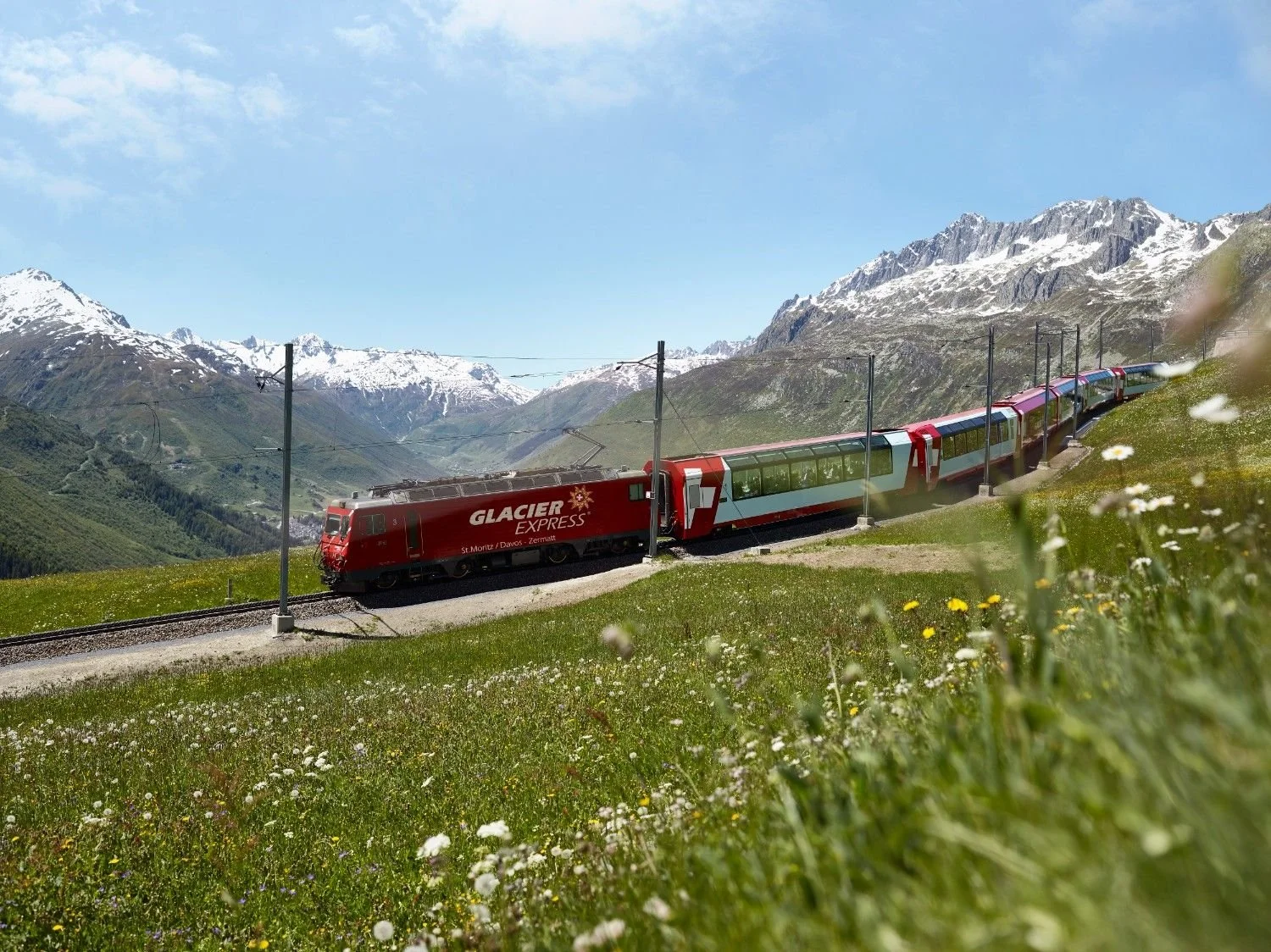
Embark on a journey like no other as we take you on an unforgettable rail adventure through the heart of the Swiss Alps. 🏔️ Sit back, relax, and let the scenic wonders unfold before your eyes. 🌄 From lush valleys to towering peaks, every moment on the Glacier Express & Bernina Express will leave you in awe. 🚂
-
Diva Destinations hosts throughout your stay
1st Class Rail travel on the world famous Glacier Express & the historic Bernina Express
Private coach transfers in Paris taking us on to our next rail journey from Paris to Strasbourg
Return Eurostar to Paris
All Rail Travel as detailed in our itinerary
Cable car in Oenschinense from Kandersteg
7 Day Swiss Rail Pass
2 night’s in 4* hotel in Strasbourg
2 night’s 4* hotel in St Moritz
3 nights 4* hotel in Kandersteg
Breakfast daily
4 Dinners
1 Lunch
100% Financial protection
-
Meals not stated
Personal Travel Insurance
Gratuities
Local Tourist tax
-
EARLY BIRD PRICES
MONTHLY PAYMENT PLANS AVAILABLE
Sole Occupancy: £6,555 | $8,800 USD
Twin or Double Room: £5,770 | $7,750 USD per person
Kindly note the USD$ rates are subject to currency exchange rates and may vary at the time of booking
-
Day 1 | 11 October - London - Strasbourg (D)
We will meet the group at London St Pancras and board the Eurostar to Paris. We have a private transfer from the Gare du Nord to the Gare de l’Est, where we continue by fast TGV to Strasbourg for the night.
2 nights in the beautiful Hotel Regent Contades. The hotel is a refined boutique hotel occupying a magnificent 19th-century neoclassical mansion in the heart of Strasbourg. It is highly regarded for its stunning pink Vosges sandstone façade, classic Belle-Époque interiors, and its excellent location on the banks of the River Ill.
We will have our welcome Group dinner in a local restaurant in Strasbourg (Included).
Day 2 | 12th October - Free Day (B)
We have the day at leisure to explore this beautiful city.
Strasbourg, straddling the Franco-German border on the Ill and Rhine, wears its dual heritage with quiet confidence. Alsace's capital passed repeatedly between France and Germany, and that history is legible everywhere: half-timbered townhouses in La Petite France, wide Germanic boulevards in the Neustadt, and a cathedral, Notre-Dame, whose rose window and astronomical clock draw the eye upward for good reason — climb the platform beneath the spire for a sweep over the old town's canals and rooftops.
The city rewards slow exploration. Wander the Grande Île's cobbled lanes, pause at the Palais Rohan for its decorative arts and archaeology collections, or take a quiet boat along the waterways that once powered the tanning and milling trades. The Musée Alsacien offers a gentler, more domestic counterpoint — carved furniture, painted ceramics, regional costume.
Strasbourg's markets are central to its character, not incidental to it: the weekly produce markets at Boulevard de la Marne and Place du Marché-aux-Poissons are worth seeking out year-round for Alsace's distinctive cheeses, charcuterie, and Riesling. A winstub lunch — choucroute, tarte flambée — completes the picture rather better than any guidebook could.
We will take our group dinner in a local restaurant (payable locally). Overnight in Strasbourg.
Day 3 | 13th October – Strasbourg - St Moritz (B,D)
Today we continue our journey to Switzerland, travelling by train to St Moritz, Switzerland’s most iconic Alpine resorts, located in the beautiful Engadin Valley in the canton of Graubünden. From Strasbourg, the line follows the Rhine's flat, vineyard-fringed plain south to Basel, Alsace's half-timbered villages giving way gradually to Swiss precision. After the change, the route climbs in earnest: from Basel toward Chur and on to St Moritz, the Rhine valley narrows, gorges deepen, and forested slopes rise toward the first real peaks. Beyond Chur, the Albula or Bernina line (depending on routing) begins its celebrated ascent — spiral tunnels, stone viaducts, and larch-clad hillsides climbing past churning glacial rivers. The final stretch opens onto the high Engadine's broad, light-filled valley, lakes glinting below the approach into St Moritz.
St Moritz has been welcoming visitors since 1864 and is famous for its stunning mountain scenery and outdoor adventures. St Moritz sits at 1,822m in the Engadine valley of eastern Switzerland, its lake ringed by larch forests and the peaks of the Bernina range. Long known for its mineral springs, the resort's modern fame began in the 1860s when hotelier Johannes Badrutt wagered English summer visitors would return for winter sunshine — they did, launching Alpine winter tourism itself. St Moritz hosted the Winter Olympics in 1928 and 1948, and remains synonymous with glamour: the Cresta Run, polo on the frozen lake, and grand belle-époque hotels. The old village, Dorf, and lakeside Bad quarter offer walking, while the Engadine museum traces local history and architecture.
Tonight we take our group dinner in the hotel restaurant (included). Overnight in St Moritz.
Day 4 | 14th October – Round trip on the Bernina Express to Tirano (B)
Today we take our 1st class seats aboard the iconic Bernina Express to Tirano passing mighty glaciers, rushing mountain streams and Alpine meadows. The line has UNESCO World Heritage status, a testament to the incredible civil engineering required to create it, and to the breathtaking scenery surrounding it. Travelling south through 55 tunnels and over 196 bridges, including the incredible Landwasser Viaduct, the track clings to the mountainside as we wind above deep ravines and past idyllic waterfalls.
Here is the Bernina Express journey in detail: less than 10km from St Moritz is Pontresina, the next stop on the rail route. It sits at the entrance to the Val Bernina on a sloping mountainside terrace, which adds to the village’s quaint majesty. The next leg of the journey, however, passes two exceptional sights: the Montebello Curve and the Morteratsch Glacier. The curve itself has a minimum radius of 45m, turning a total of 180 degrees, and remains one of the most photographed sections of the track. After this brief descent, the Bernina Express gains higher ground; the highest ground, in fact, of the Rhaetian Railway, reaching 2253m above sea level at Ospizio Bernina, your next stop. This secluded station is a beautiful sight with soft light stone walls and distinctive red shutters on its windows. The most unique stop on the Bernina Express route is Alp Grum, a restaurant exclusively accessed by rail. The journey then takes you on to Poschiavo itself, a town surrounded by rich, deep green vegetation, with a serene lake on one side. Then, the train will stop in Le Prese, a small village captured in a bubble of peace and quiet. Next, the Bernina Express takes you through to Brusio. After coming along the mountainside, the track spirals back on itself, allowing passengers plenty of time to take in the views before they descend under the viaduct they have just passed over. The Bernina Railway ends across the Italian border in Tirano, after passing orchards and vineyards, where the influences of Italy can already be seen in the architecture of the townhouses lining the riverside.
We will take our group lunch in Tirano before taking the Bernina Express back to St Moritz. Tonight we will take our Group dinner in the hotel restaurant (payable locally). Overnight St Moritz.
Day 5 | 15th October - St Moritz - Brig - Kandersteg (B,L,D)
Today we take the spectacular journey in the spacious 1st Class carriage aboard the panoramic Glacier Express. The Glacier Express offers one of the most breathtaking train journeys in the world, gliding leisurely across the Swiss Alps. Often called the “slowest express train,” it gives travellers ample time to soak in panoramic views of snow-capped peaks, deep gorges, peaceful valleys, and charming alpine villages through its enormous windows. The route winds over impressive viaducts like the Landwasser and climbs to the high Oberalp Pass, creating a sense of moving through a postcard come to life. One of the first stops about 10 minutes from St Moritz is Samedan. Nearby is Celerina, home to the Cresta Run. Built in 1884, this is one of the St Moritz area’s most famous attributes. The route takes you on to Bergrun, where you may wish to stop to visit the Bergun Railway Village, home to the Albula Railway Museum and the Railway Adventure Trail. Otherwise, ensure you take in the sight of the crystal-clear blue waters that run in the rivers. You then descend from Bergun and enter the Albula Tunnel at 1789 metres above sea level heading towards Filisur in a series of loops. Near here the Glacier Express traverses the UNESCO World Heritage Site of the Bernina Railway Line. One of the highlights of this stretch is the curve of the Landwasser viaduct, built in 1901. The train passes through Thusis and Tiefencastel, the latter of which has ochre-fronted houses, stunning, narrow stone bridges, and is crowned by a solitary tower. The Glacier Express will then take you through the Domleschg region, the area with the most castles and palaces in Switzerland. Some areas of this lush region resemble fairytale countryside, with paths sheltered by trees and shady groves. Next, you will pass through Chur, one of the oldest towns in Switzerland and the lowest altitude stop on this route, affectionately named the ‘Alpine City.’ Twisting streets, historic buildings, restaurants, bars, museums, galleries, boutiques, and a pedestrianised Old Town provide days of cultural entertainment to those staying for longer. From here, travel through the Ruinaulta, or Rhine Gorge, taking in one of the most picturesque landscapes in the Alps, which makes for a sensational experience. The winding river changes altitude beside the railway tracks, passing sheer white cliffs, hilltop towers, and slinking under arched viaducts. Nearby is Disentis which sits in the upper half of the Anterior Rhine, the Surselva. A large Benedictine monastery crowns the town, which is dominated by snow-capped chalets, mountain views, and is distinctive due to its proximity to the source of the Rhine in Tomasee. The train is heading for Andermatt and before here the Glacier Express takes you over the Oberalp Pass; a network of tunnels, viaducts, and winding roads and railway tracks. At its highest point, the Pass reaches 2044m above sea level, affording passengers in the panoramic carriages unforgettable, breath-taking views of undulating green countryside. Andermatt, nestled in the indomitable Gotthard Pass, initially avoided by the Romans, is an important North-South connection. Zig-zagging roads are dug into and supported above the craggy rocks, overlooking flat agricultural plains and clusters of white houses. The journey then continues through Fiesch and the Furka tunnel of the Furka Steam Railway that links Realp to Oberwald. This two-hour stretch weaves its way through the vast panoramas of the mountainsides, passing wooden chalets, the ice caves near the Rhone Glacier, old houses with moss-covered roofs and light stone walls, and the quaint river and bridge of Oberwald itself. Finally, the train reaches Brig in the valley, home to the 17th century Stockalper Castle, which is the emblem of Upper Valais and the largest private building built in the 17th century in the country. From Brig the train starts to climb up the valley sides again, towards St Niklaus, a village in a valley landscape punctuated by alpine chalets, rustic houses with peaked roofs, and a smattering of golden and green trees. Zermatt is at the end of the line, a majestic mountain resort, overlooked by the mighty Matterhorn. After arriving in Brig at 15:40 we will take the 16:36 train, arriving in the beautiful village of Kandersteg at 17:13 and our home for 3 nights. We will take our group dinner in a local restaurant (Included). Kandersteg is a traditiona, picteresque alpine village in the Bernese Oberland region of Switzerland, situationed on an altitude of about 1200 meters. It’s renowned for its spectacular, towering mountain scenery, sylvan landscapes and Lake Oeschinen, known as one of the most beautiful mountain lakes in the Alps, this stunning UNESCO World Heritage site is fed by glacial meltwater and features emerald waters framed by dramatic 3,000-metre cliffs. This quiet municipality of roughly 1,200 residents sits west of the Jungfrau massif and serves as a premier year-round destination for outdoor enthusiasts. We will take our dinner in the hotel restaurant (included). Overnight in Kandersteg.
Day 6 | 16th October - Kandersteg (B)
Kandersteg lies in the Bernese Oberland, at the foot of the Gemmi and Lötschberg passes, reached by rail through the Lötschberg tunnel or by road from Spiez. Far quieter than St Moritz, it has long served as a gateway rather than a destination in its own right — a staging post for alpinists and, since the early twentieth century, a base for the International Scout Movement, whose chalet here still draws visitors. The village sits amid meadows and forest below the Blüemlisalp massif, with the turquoise Oeschinen Lake, reached by cable car and footpath, its principal draw. Walking, from gentle valley strolls to high alpine routes, defines Kandersteg rather than nightlife or history.
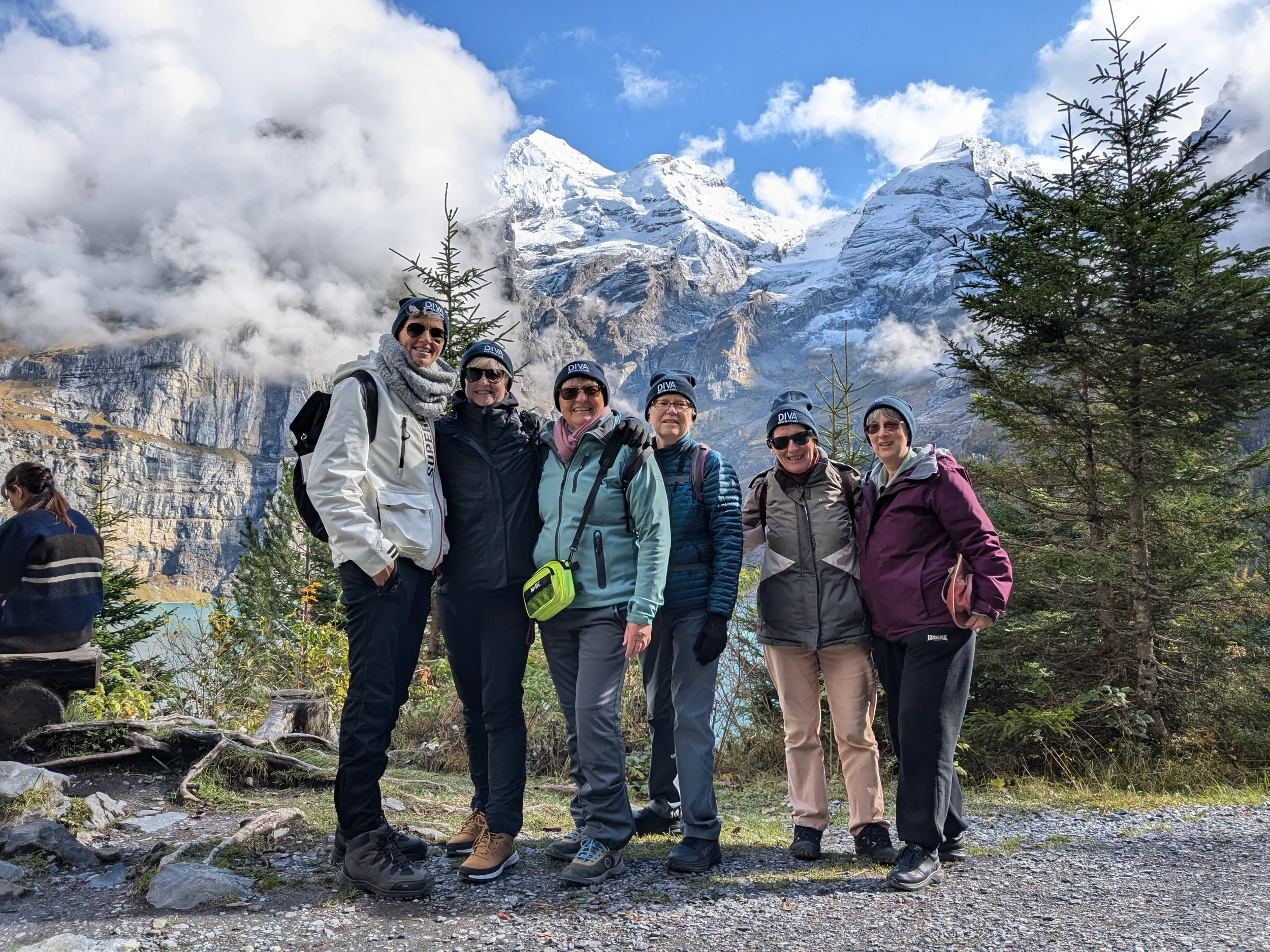
Today we have included a round trip on the Kandersteg - Oeschinen Lake cable car. The hiking trails in the Oeschinensee area are open and accessible with good footwear. The hiking time to Lake Oeschinen is about 1 hour. This vast glacial lake is fed by several brooks from surrounding mountain peaks, and the area is a joy to explore. Here we can wander at our leisure or join a guide for a hike with a chance to learn more about the local flora and fauna. Or we can simply find a peaceful spot to enjoy the sound of cowbells, clear mountain air and pretty Alpine flowers. We have our group evening meal tonight in a local restaurant (payable locally).
Day 7 | 17th October (B,D)
Today is a free day. You can wander around the stunning village or visit Naturpark Blausee, a world-famous, 20-hectare landscape, renowned for its crystal-clear, deep turquoise-blue alpine lake. Formed 15,000 years ago by a massive rock fall. Here you have forest walks, striking scenery, and unique underwater clarity where petrified trees and statues are visible up to 12 meters deep. Or, you can use your Swiss rail pass and take a day trip to Zermatt. The journey by train from Kandersteg to Zermatt takes about two hours back through Brig and Visp.
Zermatt lies at the head of the Mattertal valley in canton Valais, its approach by rail from Täsch or Visp—the village itself is car-free, reached that way since the 1960s to preserve its character. Dominated visually and historically by the Matterhorn, Zermatt grew from a modest farming and mountaineering settlement into an alpine capital after Edward Whymper's first ascent of the peak in 1865, a triumph shadowed by tragedy when four of his party died descending. The old village retains weathered wooden granaries on stone stilts alongside grand hotels. Skiing, climbing, and the Gornergrat railway's views of the Matterhorn define the place today.
Tonight we take our farewell dinner in a local restaurant (included). Overnight Kandersteg.
Day 8 | 18th October (B) Kandersteg – London
Our holiday draws to an end today as we leave Kandersteg for Paris.
From Kandersteg the line drops through the Lötschberg tunnel and down the Kander valley to Spiez, Lake Thun glinting below with the Bernese peaks receding behind. The route continues north via Bern to Basel, Switzerland's plateau flattening out as the city's Rhine crossing approaches. Beyond Basel, the TGV Lyria cuts west through the wooded hills of the Franche-Comté and Burgundy — Belfort, Besançon, rolling vineyards and pastureland — before the landscape opens into the broad agricultural plains that run all the way to Paris, arriving at Gare de Lyon. We are transferred across Paris to the Gare du Nord, where we board the Eurostar back to London St Pancras to say our fond farewells.
Swiss Alps 2027 | 11 - 18 October 2027 | £1200
WE DO REQUIRE A MINIMUM GROUP NUMBER. THEREFORE, WE ASK YOU NOT TO BOOK ANY TRAVEL ARRANGEMENTS UNTIL WE CONFIRM OUR DEPARTURE.